By the TC Golf Center Editorial Team · Updated · How we choose products
The best golf irons for most golfers in 2026 are the PING G440. They are a cast game improvement iron with a 29 degree 7-iron, and Golf Monthly's review called them easy to launch and very forgiving. Mid handicappers who want a smaller head should look at the TaylorMade P790. If price matters most, the Wilson Dynapwr launched at $899 for a seven-piece set.
- Best for Most Golfers PING G440 Irons A cast game improvement iron with a face PING says is 9 percent thinner than the G430, priced at $170 per iron in steel at launch.Check Price
- Best for Mid Handicappers TaylorMade P790 Irons A foam-filled hollow body with a forged face and a 30 degree 7-iron in a compact players shape.Check Price
- Best Value Wilson Dynapwr Irons A hollow body distance iron that launched at $899 for seven clubs, well below the other sets here.Check Price
This page covers one iron from each category, so there is a pick for every level from a new golfer to a scratch player. The picks are based on manufacturer specifications and published independent reviews. Prices are launch MSRP in US dollars, and street prices vary. Each category also has its own guide with more options, linked in the sections below.
Quick Comparison
| Iron | Category | Best For | 7-iron loft | Launch MSRP |
|---|---|---|---|---|
| PING G440 | Game improvement | Most golfers | 29° | $170 per iron, steel |
| Callaway Quantum Max OS | Super game improvement | High handicappers | 29° | $1,149.99 for 7 irons, steel |
| TaylorMade P790 | Players distance | Mid handicappers | 30° | $1,399.99 for 7 irons, steel |
| Titleist T100 | Players cavity back | Low handicappers | 33° | $215 per iron |
| Mizuno Pro S-1 | Muscle back blade | Elite ball strikers | 34° | $215 per iron |
| Wilson Dynapwr | Game improvement | Best value | 28° | $899 for 7 irons, steel |
PING G440 Irons
PING announced the G440 in January 2025 as the successor to the G430, at $170 per iron with a steel shaft and $185 with graphite. The head and face are cast from 17-4 stainless steel. Golf Digest reported that a new heat treatment allowed a variable-thickness face that is 9 percent thinner than the G430 face. PING moved the saved weight lower and farther back in the head to lower the center of gravity and help launch. A four-piece PurFlex cavity badge sits behind the face.
The standard 7-iron loft is 29 degrees. PING also offers a Power Spec at 27.5 degrees and a Retro Spec at 31 degrees, which lets a fitter trade distance for height without changing models. Golf Monthly's review described the G440 as very confidence-inspiring at address, easy to launch, and very forgiving. Its one criticism was about looks on the shelf. Our game improvement irons guide compares the G440 with the Callaway Elyte HL, TaylorMade Qi, and others.
Who it's for: Mid and high handicappers who want forgiveness and easy launch, which describes most golfers who buy irons.
Callaway Quantum Max OS Irons
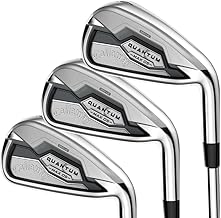
The Quantum Max OS is the super game improvement model in Callaway's 2026 Quantum iron family, which also includes the Quantum Max and Quantum Max Fast. The irons reached retail on February 27, 2026. GolfWRX listed the Max OS at $164 per club, or $1,149.99 for a seven-piece set in steel. Callaway describes the head as an oversized shape designed to help golfers hit the ball more solidly across the face. Its spec chart lists a 29 degree 7-iron, with a 31 degree high launch spec available by custom order.
The Quantum irons use what Callaway calls a 360 Undercut Cavity, a two-piece design with perimeter weighting and an exposed undercut. Golfalot's review of the range also notes an AI-designed face and urethane microspheres that absorb vibration. MyGolfSpy ranked the Quantum Max OS second overall in its 2026 super game improvement iron test. For more options at this level, see our list of the most forgiving irons.
Who it's for: High handicappers and newer golfers who need the largest head and the most help on mishits.
TaylorMade P790 Irons
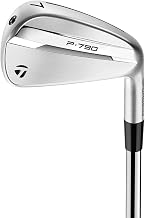
The current P790 is the fifth generation of TaylorMade's players distance iron. Preorders opened on February 18, 2025, and it reached retail on March 13, 2025, at $1,399.99 for a seven-piece set in steel and $1,499.99 in graphite. The head is a hollow body filled with SpeedFoam Air. The face is forged from a steel TaylorMade calls 4340M, which the company says is 20 percent stronger than the previous face material. The 4-iron through 7-iron have a Thru-Slot Speed Pocket to protect ball speed on low strikes.
The 7-iron loft is 30 degrees, only one degree weaker than the PING and Callaway irons above, in a much more compact head. TaylorMade's FLTD CG design places the center of gravity lower in the long irons and higher in the short irons. Golfalot's review gave a handicap range of 5 to 18 and praised the blend of distance and forgiveness. It also found no real improvement over the previous generation and noted the rising price.
Who it's for: Mid handicappers who strike the ball fairly consistently and want distance without an oversized head.
Titleist T100 Irons
Titleist released the current T-Series in 2025, with fittings from July 10 and retail availability on August 21. Pricing was $215 per club, or $1,499 for a seven-piece set in steel. The T100 is the fully forged players cavity back in the line. Golf.com reported split high-density tungsten low in the head, a variable thickness face in the 3-iron through 7-iron, and a new muscle channel in the 3-iron and 4-iron to raise launch.
Titleist made this T100 one degree stronger than the previous version, which puts the 7-iron at 33 degrees. Golfalot's review found tight left-to-right dispersion and consistent results. It also called the irons demanding and gave a handicap range of 0 to 5. Golfers who like the look and want more help can move to the T150 at 32 degrees or the T250 at 30.5 degrees. Our best cavity back irons guide covers more models in this category.
Who it's for: Low handicappers who value distance control and feel over extra yardage.
Mizuno Pro S-1 Irons
The Mizuno Pro S-1 is a single-piece forged muscle back that reached retail on September 11, 2025, at $215 per club. It is forged from 1025E Pure Select mild carbon steel using Mizuno's Grain Flow Forged HD process, with a copper underlay beneath the finish. Golf.com reported that tour players Keith Mitchell and Ben Griffin gave feedback during the design.
A channel cut across the back lets Mizuno control where mass sits, and the company says this raises vertical stability for a more consistent launch. Compared with the earlier Pro 241, the sole is flatter with a sharper leading edge and one more degree of bounce. The 7-iron loft is 34 degrees, the weakest on this list, so expect less distance per club than the other picks. See our best blade irons for alternatives, or read blades vs cavity back irons before committing to a muscle back.
Who it's for: Scratch and near-scratch golfers who find the center of the face consistently and want to shape shots.
Wilson Dynapwr Irons
Wilson launched the Dynapwr irons on January 29, 2025. Plugged In Golf listed the price at $899 for a seven-piece set, which is about $250 below the Callaway set and $500 below the TaylorMade set on this list. The construction is a hollow body. Wilson's named technologies are the PKR-Cup Face, the Energy Transfer Chassis, and the Velocity Optimization Channel.
The 7-iron loft is 28 degrees, the strongest here. Plugged In Golf's review said the set does not give up distance or forgiveness for its price. It also advised most golfers to skip the 4-iron unless they have high club speed and a high launch. Golfalot's review noted low spin rates, especially in the long irons, which can make it harder to stop the ball on a green. Wilson also sells a Dynapwr Max with a wider sole and larger profile. More low-cost sets are in our best budget golf irons guide.
Who it's for: Mid and high handicappers who want a current distance iron from a major brand at the lowest price on this list.
Buying Guide
Iron Categories by Handicap
Irons fall into five broad categories. Super game improvement irons have the largest heads and suit high handicappers, roughly a handicap index of 20 or more. Game improvement irons fit most mid and high handicappers. Players distance irons add speed to a compact head and suit mid to low handicappers. Players cavity backs and blades are for low handicappers who rarely miss the center of the face. These ranges are guides. Choose by how consistently you strike the ball, not by the handicap you hope to reach.
Loft and Distance
The number on the sole does not tell you the loft. The 7-irons on this page range from 28 degrees to 34 degrees, a gap of six degrees. A stronger loft sends the ball farther and lower, so part of any distance gain between sets comes from loft alone. Compare lofts before you compare distance claims, and check that the set leaves sensible gaps down to your wedges.
Forged vs Cast
Forged heads are pressed from a billet of steel, and cast heads are poured into a mold. The Titleist T100 and Mizuno Pro S-1 are forged. The PING G440 is cast. Casting allows the hollow shapes and deep undercut cavities that add forgiveness, and several irons combine a forged face with a cast or hollow body. Head design affects forgiveness far more than the manufacturing method does.
Shafts
Steel shafts are heavier and are the stock choice in most of these sets. Graphite shafts are lighter, which can help golfers with slower swings or joint pain, and they usually add to the price. Our guides to steel vs graphite iron shafts and the best iron shafts cover the choice in detail.
Set Makeup
Set prices on this page are for seven clubs. Which seven clubs depends on the brand, so check whether the set starts at the 4-iron or the 5-iron and whether it includes a gap wedge. PING, Titleist, and Mizuno quote prices per club, which makes it easy to order only the irons you will use. Many golfers replace the 4-iron with a hybrid.
Fitting
A fitting sets shaft, length, lie angle, and loft for your swing. PING offers the G440 in three loft specs, and Callaway offers a high launch spec on the Quantum Max OS by custom order, so the same model can play differently from one build to the next. A fitting also shows whether you have enough speed to launch the longest irons in a strong-lofted set.