
By the TC Golf Center Editorial Team · Updated · How we choose products
The best cavity back irons in 2026 are the Titleist T100 for low handicappers and the PING G440 for most other golfers. The T100 is a fully forged players cavity back with a 33 degree 7-iron. The G440 is a cast game improvement cavity back with a 29 degree 7-iron. If price matters most, the Tour Edge Hot Launch E525 launched at $80 per iron.
- Best Players Cavity Back Titleist T100 Irons A fully forged, compact cavity back with tungsten weighting and a 33 degree 7-iron.Check Price
- Best Game Improvement PING G440 Irons A cast cavity back with a 29 degree 7-iron, three loft specs, and a launch price of $170 per iron in steel.Check Price
- Best Budget Tour Edge Hot Launch E525 Irons A cast cavity back with a 360 degree undercut that launched at $80 per iron.Check Price
This page groups cavity backs by type. Three players cavity backs come first, then two game improvement cavity backs, then one budget set. The picks are based on manufacturer specifications and published independent reviews. Prices are launch MSRP in US dollars, and street prices vary. Hollow body irons such as the TaylorMade P790 are a different construction and are left out. They are covered in our best golf irons guide.
Quick Comparison
| Iron | Type | Best For | 7-iron loft | Launch MSRP |
|---|---|---|---|---|
| Titleist T100 | Players cavity back, forged | Low handicappers | 33° | $215 per iron |
| Mizuno Pro S-3 | Players cavity back, forged | Feel and shot shaping | 34° | $200 per iron |
| PING i240 | Players cavity back, cast | More help in a players shape | 33° | $200 to $217 per iron, sources differ |
| PING G440 | Game improvement cavity back | Most golfers | 29° | $170 per iron, steel |
| Callaway Quantum Max | Game improvement cavity back | Distance and forgiveness | 29° | $1,149.99 for 7 irons, steel |
| Tour Edge Hot Launch E525 | Budget cavity back | Lowest price | 27.5° | $80 per iron |
Titleist T100 Irons
Titleist released the current T100 in 2025 as part of a new T-Series. Golf Digest reported retail availability on August 21 at $1,499 for a seven-piece set in steel, which is about $215 per club. The head is fully forged with a dual-cavity construction and tungsten weighting. Golfalot's review also lists a variable thickness face in the 3-iron through 7-iron and a muscle channel in the 3-iron and 4-iron.
The lofts are one degree stronger than the previous T100, and the 7-iron is 33 degrees. Golfalot praised the left-to-right dispersion and the consistent results. It also said the irons are only for good ball strikers, noted a drop in performance into the wind, and gave a handicap range of 0 to 5.
Who it's for: Low handicappers who want a compact forged head and predictable distances.
Mizuno Pro S-3 Irons
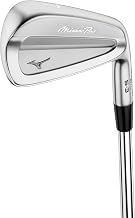
The Mizuno Pro S-3 went on sale in February 2025 at $200 per iron. It is a shallow cavity back that Golf.com described as sitting between Mizuno's 241 blade and 243 cavity back. The head is Grain Flow Forged from 1025E Pure Select mild carbon steel with a copper underlay beneath the finish. Mizuno's Triple Cut sole bevels the leading edge and cuts away the trailing edge.
The 7-iron loft is 34 degrees, the weakest on this page, so expect less distance per club than the other picks. National Club Golfer rated the S-3 4.5 out of 5 and praised its feel, looks, and consistency. The same review said it may not suit inconsistent ball strikers. Golfers who want an even smaller head can compare it with our best blade irons.
Who it's for: Low handicappers who put feel and shot shaping ahead of distance and forgiveness.
PING i240 Irons
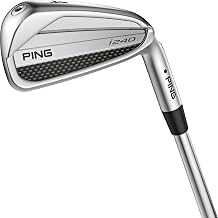
PING launched the i240 in July 2025. Published launch prices differ. Golf.com reported $200 per club, and Golf Digest reported $217 per club in stock steel. Unlike the two irons above, the i240 is cast, from 431 stainless steel. An elastomer insert sits behind the face, and Golf.com reported that the cavity badge is 8.5 grams lighter than the badge in the earlier i230. PING says the saved weight goes to the perimeter of the head to raise MOI.
The standard 7-iron loft is 33 degrees. PING also lists a Power Spec at 31.5 degrees and a Retro Spec at 35 degrees. Golf.com's reviewer wrote that PING set out to make a players iron with game improvement forgiveness and succeeded, and called the i240 the best-feeling PING iron the reviewer had hit.
Who it's for: Single-digit and low double-digit handicappers who want a players shape with more help than a forged cavity back gives.
PING G440 Irons
The G440 is PING's game improvement cavity back. It reached retail on January 30, 2025, at $170 per iron with a steel shaft and $185 with graphite. The head and face are cast from 17-4 stainless steel, with a multi-material PurFlex badge in the cavity. Launch coverage reported a face that is 9 percent thinner than the face of the previous model.
The standard 7-iron loft is 29 degrees, four degrees stronger than the T100 and i240. A Power Spec at 27.5 degrees and a Retro Spec at 31 degrees are also available. The G440 is also a pick in our best game improvement irons guide, which compares it with more sets of this type.
Who it's for: Mid and high handicappers who want forgiveness and easy launch.
Callaway Quantum Max Irons
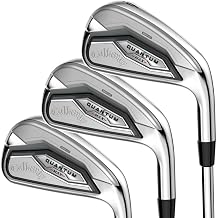
The Quantum Max is Callaway's 2026 game improvement iron. It reached US retail on February 27, 2026, at $164 per club, or $1,149.99 for a seven-piece set in steel. Callaway builds it around what it calls a 360 Undercut Cavity, a two-piece construction with perimeter weighting and a fully exposed undercut. Golfalot's review also notes an AI-designed face and urethane microspheres that absorb vibration.
The 7-iron loft is 29 degrees. Golfalot scored the Quantum Max 4.3 out of 5 and gave a handicap range of 12 and up. It found the irons easy to hit, with good forgiveness and plenty of ball speed. Its criticisms were a firmer feel and a chunkier look than the Elyte irons that the Quantum line replaces. Callaway also sells a larger Quantum Max OS, and our most forgiving irons guide covers that end of the range.
Who it's for: Mid and high handicappers who want a current-year cavity back built for distance and forgiveness.
Tour Edge Hot Launch E525 Irons
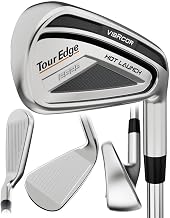
The Hot Launch E525 launched in early 2025 at $80 per iron, less than half the per-club price of any other iron here. It is a perimeter-weighted, wide-soled cavity back cast from 431 stainless steel. A 360 degree undercut in the cavity lets the face flex more, extra mass sits in the toe, and a urethane material Tour Edge calls VIBRCOR fills the undercut pocket to soften sound and feel.
The 7-iron loft is 27.5 degrees and the pitching wedge is 42 degrees, the strongest lofts on this page. Plugged In Golf's review called the E525 ideal for the mid handicap player who does not always find the center of the face and wants more distance. Tour Edge released a hollow body successor, the Hot Launch Max, in 2026, so check that the E525 is still in stock before ordering. Lower-priced boxed sets are in our best budget golf irons guide.
Who it's for: Mid and high handicappers who want a new cavity back set at the lowest price on this list.
Buying Guide
What Is a Cavity Back Iron?
A cavity back has metal removed from the middle of the back of the head. That weight moves to the heel, the toe, and the sole, which is called perimeter weighting. Weight at the edges raises the head's moment of inertia, or MOI, so the head twists less on an off-center strike and the shot loses less distance and direction. A blade keeps its mass behind the center of the face. Our blades vs cavity back irons comparison covers the differences in detail. A hollow body iron is a third design, with an enclosed chamber where a cavity back has an open back.
Players vs Game Improvement Cavity Backs
A players cavity back has a compact head, a thin top line, a narrow sole, little offset, and a shallow cavity. The T100, Pro S-3, and i240 are in this group. A game improvement cavity back has a larger head, a wider sole, more offset, and a deeper cavity, often with an undercut behind the face. The G440, Quantum Max, and Hot Launch E525 are in this group. The first type gives more feedback and control of trajectory. The second type gives more help on mishits and a higher launch for a given loft.
Forged vs Cast
Forged heads are pressed from a billet of steel, and cast heads are poured into a mold. The T100 and Pro S-3 are forged. The i240, G440, and Hot Launch E525 are cast. Casting allows deep undercut cavities that are hard to forge. The i240 shows that a compact players cavity back can be cast, so the manufacturing method does not define the category. Head shape and weight placement affect forgiveness more than the method does.
Lofts
The 7-irons on this page range from 27.5 degrees to 34 degrees, a gap of 6.5 degrees. The three players cavity backs sit at 33 or 34 degrees, and the three game improvement models sit at 27.5 to 29 degrees. A stronger loft sends the ball farther and lower, so part of the distance difference between the two types comes from loft alone. Compare lofts before you compare distance claims, and check the gaps down to your wedges. A 42 degree pitching wedge leaves more room to fill than a 46 degree one.
Who Should Play Cavity Backs?
Most golfers should. Players who miss the center of the face often, which includes most mid and high handicappers, are better served by a game improvement cavity back. Players who strike the ball consistently and want more feedback can move to a players cavity back. Strike consistency matters more than the number, but our guide to what counts as a good golf handicap gives context for where you stand. A fitting with a launch monitor shows the spread of your carry distances with each head, which is a better basis for the choice than a handicap chart.